
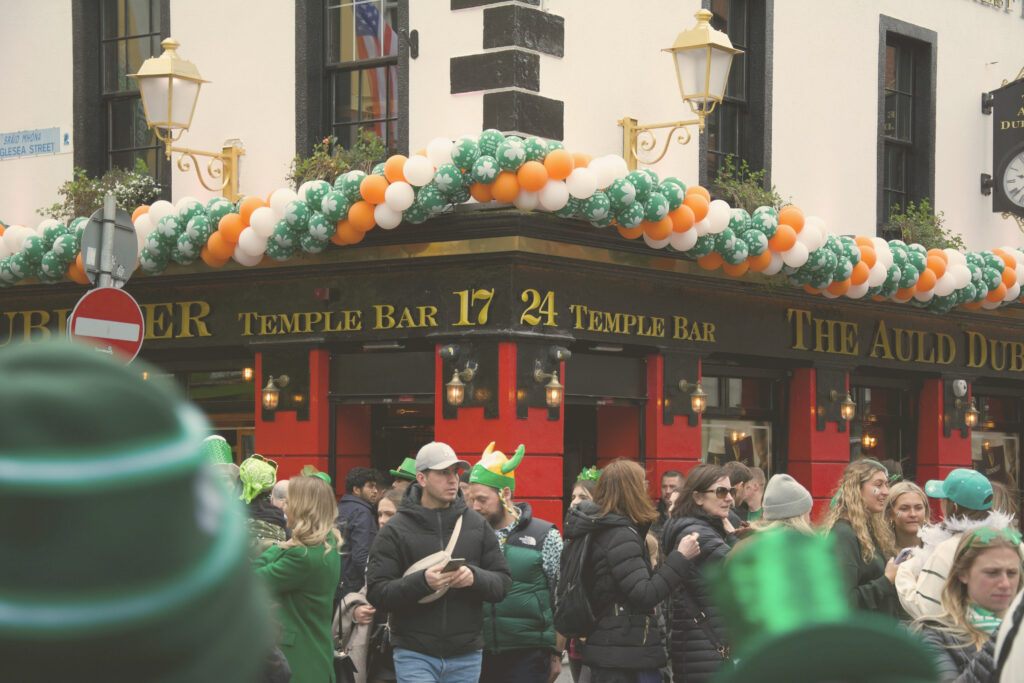
Every year, St. Patrick’s Day rolls around and we celebrate—but most people don’t know the true origins of St. Patrick’s Day ☘️
Here’s the thing…
St. Patrick’s Day didn’t start as a celebration.
And it definitely didn’t start the way most of us think.
To really understand it, we have to go back—
before St. Patrick, before Christianity in Ireland,
to a completely different version of the world.
THE ORIGINS OF ST. PATRICK’S DAY IN PAGAN IRELAND
Long before St. Patrick ever set foot in Ireland, the island was deeply rooted in pagan traditions.
These weren’t random or chaotic belief systems. They were structured around:
- nature
- seasonal cycles
- a sense of balance between people and the land
Spirituality wasn’t separate from daily life—it was woven into it.
Spring, especially, was a time of renewal. Of rebirth. Of reconnecting with the rhythms of the earth.
This way of life wasn’t fading away on its own.
It was intentionally replaced.
ENTER ST. PATRICK (AND THE SPREAD OF CHRISTIANITY)
St. Patrick is often remembered as the patron saint of Ireland—but he wasn’t originally Irish.
He was a missionary sent to convert the Irish people to Christianity.
And here’s where it gets interesting…
The spread of Christianity in Ireland didn’t always happen by completely erasing what was already there.
Instead, it often happened through adaptation and reinterpretation.
Rather than removing familiar symbols and ideas, they were reshaped.
One of the most well-known examples?
The shamrock.
THE SHAMROCK: A REBRANDED SYMBOL
According to tradition, St. Patrick used the shamrock—a common plant in Ireland—to explain the concept of the Christian Trinity (Father, Son, and Holy Spirit).
Three parts. One whole.
It was simple, visual, and already familiar to the people he was trying to reach.
In other words:
A symbol from the land…
used to teach a new belief system.
It made conversion feel more accessible. More understandable.
Less like something entirely foreign.
THE STORY OF THE “SNAKES”
You’ve probably heard the story that St. Patrick “drove the snakes out of Ireland.”
It’s one of the most widely repeated parts of his legacy.
There’s just one problem…
Ireland never had snakes.
According to sources like National Geographic, Ireland never had native snake populations.
So what does the story actually mean?
Many historians interpret the “snakes” as symbolic—representing the pagan traditions and spiritual practices that existed before Christianity.
If that’s the case, then this story isn’t about animals at all.
It’s about the removal of an existing belief system and the rise of another in its place.
MORE THAN RELIGION: A SHIFT IN STRUCTURE
This transformation wasn’t only spiritual—it reshaped society.
Pagan traditions often emphasized:
- connection to nature
- cyclical thinking (life, death, rebirth)
- a sense of balance
As Christianity spread, it introduced:
- more centralized authority
- structured hierarchy
- defined doctrine
This wasn’t just a change in belief.
It was a shift in how society functioned—who held power, and how it was expressed.
This idea is key to understanding the origins of St. Patrick’s Day.
THE STORY CHANGES AGAIN: IRISH IDENTITY IN AMERICA
Fast forward centuries later…
When Irish immigrants came to the United States, they weren’t exactly welcomed with open arms.
They faced:
- discrimination
- anti-Catholic bias
- pressure to blend in and become “American”
So St. Patrick’s Day took on a new meaning.
It became more than a religious observance.
It became a way to:
- hold onto identity
- celebrate heritage
- be visible in a society that often tried to erase or diminish them
Parades, gatherings, public celebrations—these weren’t just parties.
They were statements.
We’re still here. And we’re proud of who we are.
What started as something shaped by control…
became something reclaimed through resilience.
WHY THIS STORY FEELS FAMILIAR
If parts of this feel familiar, you’re not imagining it.
Across history, dominant systems have often replaced or suppressed native belief systems—sometimes by force, sometimes through rebranding and adaptation.
You can see similar patterns in the United States, where Indigenous cultures and spiritual practices were pushed aside in the name of expansion and religion.
This isn’t about saying every situation is identical.
It’s about recognizing a pattern.
And once you see it…
you start to notice it in more places than one.
SO WHAT ARE WE REALLY CELEBRATING?
So where does that leave us?
St. Patrick’s Day, as we know it today, isn’t just one story.
It’s layers of:
- pagan tradition
- religious transformation
- cultural identity
- resilience
And honestly…
That doesn’t make the holiday less meaningful.
If anything, it makes it more.
Because now, instead of just celebrating a surface-level version of the holiday,
you understand the depth behind it.
History doesn’t ruin the magic.
It makes it deeper.
And when you start to understand the stories behind the things we celebrate,
you don’t just see traditions…
You start to see the world differently.
If you love uncovering the real stories behind the traditions we celebrate, you might also like:
→ The real origins of Christmas
→ The hidden history of Easter
There’s always more beneath the surface ✨
exploring:

Leave a comment