
Why Many Americans Missed the Symbolism in Bad Bunny’s Halftime Show — A History Teacher’s Perspective
For almost a decade, I taught U.S. history. From inside the classroom, I saw how Puerto Rico is framed — and the textbooks are not exactly straightforward about Puerto Rico’s history. I wasn’t explicitly told to obscure it, but I know this because of how the curriculum is written and how the textbooks present it. That background shapes how I interpret the Bad Bunny Super Bowl halftime show symbolism today.
In most high school courses, Puerto Rico is described as a “territory”, a “commonwealth”, or “protectorate.” These words sound neutral. Administrative. Technical.
What they often obscure is this: Puerto Rico has been a U.S. colony since 1898.
Puerto Ricans are U.S. citizens. But they cannot vote for president. They do not have voting representation in Congress. Major political and economic decisions about the island are often made in Washington rather than by people living there.
That reality is rarely centered in textbooks. The framing is softer. And when framing is soft, public understanding becomes soft.
That context matters when we talk about Bad Bunny’s Super Bowl halftime show.
Because without it, the symbolism looks like spectacle.
With it, it looks like a history lesson.
That context is why the Bad Bunny Super Bowl halftime show symbolism mattered far more than most viewers realized.
The Language We Use — and What It Leaves Out
When U.S. expansion is taught in American schools, it’s usually framed as a geopolitical moment: the Spanish-American War, new territories acquired, strategic positioning.
It’s presented as policy.
It’s almost never framed as empire.
Rarely do we call Puerto Rico what it has functioned as for over a century: a colony.
Rarely do we pause to examine how language shapes perception. “Territory” feels different than “colony.” One sounds temporary and bureaucratic. The other signals power imbalance.
So when a Puerto Rican artist uses one of the largest cultural stages in the United States to tell a story rooted in colonial history, many Americans don’t have the background knowledge to decode it.
Not because they’re incapable.
But because that lens was never fully developed in the classroom.
I’ve written before about how global awareness is a skill we’re rarely taught — and how that gap shapes the way we interpret moments like this.
The Sugarcane Fields
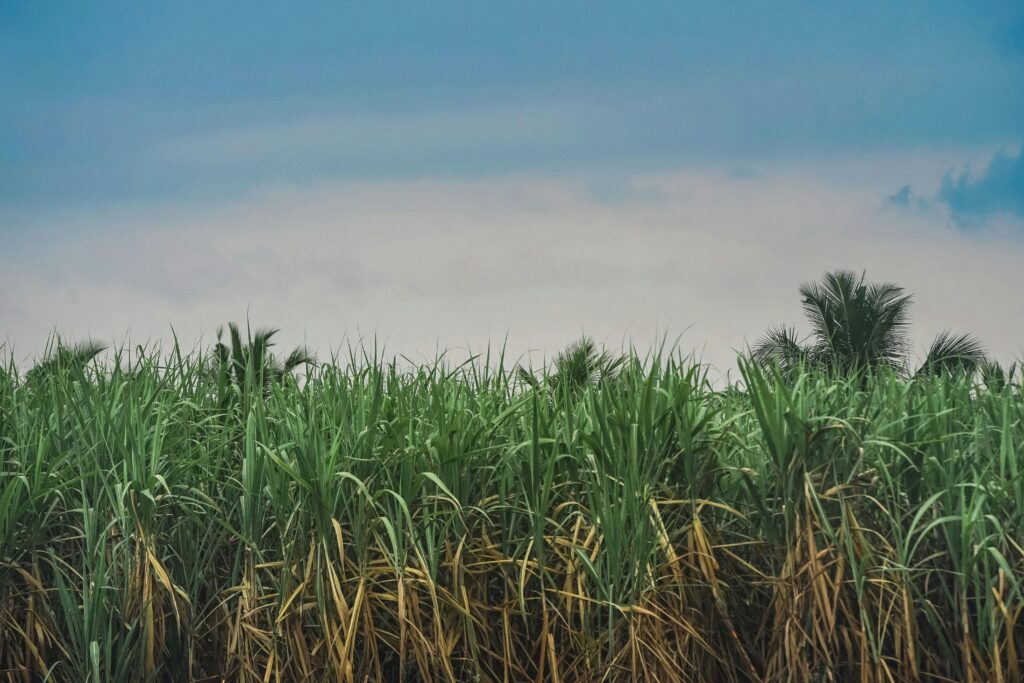
The performance opens in sugarcane fields.
That isn’t aesthetic. It’s historical.
Sugar dominated Puerto Rico’s economy under Spanish colonization and continued to shape it under U.S. governance. It represents extraction — wealth built from land and labor that did not equally benefit the people living on that land.
Opening in the sugarcane fields centers labor before fame. History before celebrity.
It roots the performance in colonial economic reality.
This moment is one of the clearest examples of Bad Bunny’s Super Bowl symbolism tied directly to Puerto Rico’s colonial past.
Everyday Life as Cultural Anchor
Throughout the show, we see fruit vendors, domino players, nail salon workers, neighborhood gathering spaces.
These are not aesthetic backdrops.
They are cultural anchors.
Culture does not survive in textbooks. It survives in community — in domino tables, bodegas, salons, block parties, and social clubs. These everyday spaces are especially important within diaspora communities.
There was also a clear nod to New York’s Puerto Rican population — one of the largest Puerto Rican communities outside the island. Puerto Rican identity is not confined by geography. It exists both in Puerto Rico and across the mainland United States.
And then there was Toñita — the owner of the Caribbean Social Club in New York. A real person. An elder who has spent decades preserving Puerto Rican culture in her community. Her presence wasn’t a cameo. It was recognition.
Culture survives because someone protects it long before it becomes mainstream.
Understanding that context is part of what it really means to travel with purpose.
“El Apagón,” Infrastructure, and Hurricane Maria
When Bad Bunny performed El Apagón (“The Power Outage”) and climbed an electric pole, that was not metaphor.
Puerto Rico’s electrical grid has been unstable for decades, with recent outages again leaving large parts of the island without power. Power outages are not rare events. They are routine.
In a recent example, after Hurricane Maria in 2017, the island experienced the longest blackout in U.S. history. Recovery was slow, uneven, and deeply controversial. The crisis exposed how fragile the island’s infrastructure had become and how entangled it was in federal decision-making.
Infrastructure is political.
The decision to perform that song, in that way, on that stage, made something invisible and distant to many Americans suddenly visible and even relatable.
The Light-Blue Puerto Rican Flag
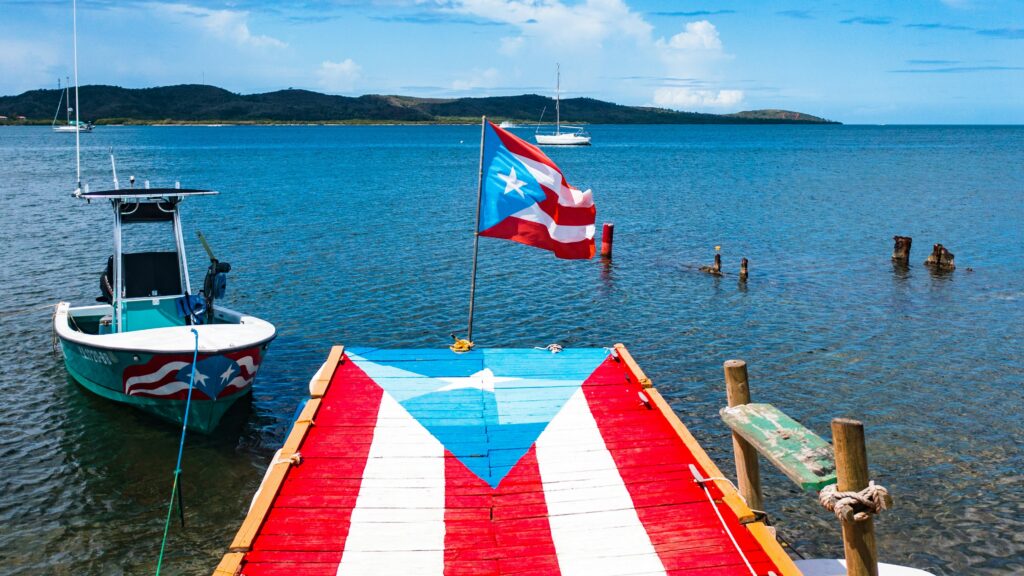
One of the most discussed details was the shade of blue in the Puerto Rican flag used during the performance.
Puerto Rico’s flag was originally designed in 1895 by independence activists inspired by the Cuban flag. Over time, the shade of blue has varied. The lighter “sky blue” version has often been embraced by pro-independence supporters, while darker versions have become more common in official use.
The color itself has become symbolic. It’s another layer of Bad Bunny Super Bowl halftime show symbolism woven into the performance.
Using the lighter blue in a performance like this is not accidental. It nods to Puerto Rico’s ongoing debate about who should control its future.
That debate is real and complex. Some advocate for statehood, arguing it would bring full representation in Congress and potentially more consistent federal support. Others advocate for independence or enhanced autonomy, concerned about cultural preservation, economic control, and historical patterns of displacement.
Ricky Martin’s performance of Lo Que Le Pasó a Hawaii reinforced that tension. The song draws parallels between Puerto Rico and Hawaii — both acquired by the United States in 1898 — and reflects anxiety about loss of culture and being pushed out of their lands. For some Puerto Ricans, what happened to Native Hawaiians before and after statehood serves as a cautionary example — a warning about cultural erasure and the loss of local control.
Martin’s presence also carried generational weight. As one of the artists who helped usher Latin music into mainstream U.S. pop in the late 1990s, he paved part of the path that allows artists like Bad Bunny to headline in Spanish today. His participation wasn’t just nostalgic — it acknowledged lineage.
Language, Assimilation, and Cultural Autonomy
The performance was primarily in Spanish.
No translation. No accommodation.
For some viewers, that may have felt like exclusion.
But the history of the United States is deeply tied to assimilation — the expectation that marginalized communities adapt linguistically and culturally in order to be accepted.
Centering Spanish on that stage wasn’t about shutting people out for the sake of exclusion.
It was about refusing erasure.
It was about existing publicly without reshaping identity for comfort.
When Lady Gaga joined the performance wearing a sky-blue dress and a brooch featuring the flor de maga — Puerto Rico’s national flower — and sang in Spanish, the symbolism shifted again. Instead of Puerto Rican culture adapting to mainstream expectations, a mainstream artist visibly stepped into Puerto Rican cultural space.
That inversion is subtle, but meaningful.
Redefining “America”
The performance ended with “God Bless America.”
And then Bad Bunny named countries across North, Central, and South America.
That moment landed deeply for me because of something I experienced while teaching.
Over the years, many academics shifted from calling the course “American History” to “U.S. History.” The reasoning was simple: “America” technically refers to continents — North America and South America — not just the United States.
That reframing matters.
By naming the Americas, the performance expanded the meaning of “America” beyond a single nation. This reminds viewers that America is bigger than one country. Reminding viewers that Puerto Rico’s story is part of a broader Pan-American history of colonization, resistance, migration, and survival.
It was not anti-American.
It was expansive.
Unity, Love, and Why This Message & Messenger Matters
The scoreboard behind the performers read: “The only thing more powerful than hate is love.”
That line felt intentional.
At a time when the United States feels deeply polarized — politically, culturally, socially — the final message was unity.
And that unity was coming from an artist from a place that has long existed in political ambiguity within the U.S. system.
That’s powerful.
It’s not naïve. It’s not simplistic. That’s aspirational.
Why All of This Matters
When we slow down and examine the Bad Bunny Super Bowl halftime show symbolism, the performance stops feeling like entertainment and starts feeling like context.
If many Americans didn’t immediately recognize the symbolism in that halftime show, it’s not because they weren’t paying attention.
It’s because the fuller story of Puerto Rico — its political status, its colonial history, its debates over statehood and independence — is rarely centered in how we teach U.S. history.
Education shapes perception.
Art sometimes fills in the spaces curriculum leaves thin.
Bad Bunny didn’t stop to explain every symbol.
He didn’t need to.
The story was already there — for those who knew the context.
And maybe now, more people understand the history and symbolism behind this moment.
exploring:

Leave a comment